 Join the Discord!
First off, I’m thrilled to announce that Monster Wasteland is going to be at TokenCon in Oklahoma City next month! It’s going to be really cool, I look forward both to demoing my game and to playing some of the other cool, original games on their schedule. We’ve got a bunch of work to do before then – I’m making a different iteration of the map that’s more demo-friendly, resizing cards, and making icons easier to identify. A bunch of little quality of life tweaks that nonetheless take a lot of time.
So naturally, I’m procrastinating on that to share some feelings on The Lord of the Rings: Duel for Middle Earth, the two-player card collecting strategy game from the creators of Seven Wonders Duel.
I’ve been waiting to play D4ME for about a year or so. Hell, it’s been sitting on my shelf, unplayed and calling to me, since December. This is for a few reasons: first, I’m a big fan of two-player games in general. I’ve played Onitama more than I’ve played chess, Patchwork is one of my favorite rules-light games of all time, and I’m of course enamored by D4ME’s spiritual predecessor, Seven Wonders Duel. As someone who’s mostly dabbled in making co-op games, the nuances of making a specifically 1v1 game are fascinating to me. Balancing these tight mechanics and creating a tete-a-tete with minimal randomness or chances for another player to run away with the game is quite the feat, and I was excited to see how D4ME pulls it off.
It’s DUEL, not Dual
Reviews for Duel for Middle Earth sometimes boil down to “it’s Seven Wonders Duel, but better!” The comparisons are inevitable, and fair warning: I’m going to give into them as well. It’s essentially the same gameplay loop: lay out a labyrinth of known and hidden cards, take a skill, gold, or battle card from the overlapping maze, reap the rewards, and strategize future turns around your collection as well as your opponents’ assumed goals. D4ME injects flavor into the formula, with one player taking the role of the Fellowship and the other the role of Sauron. There’s also MUCH more confrontation, both in the card selection strategy and in the battle map at the center of the game. But I find the primary difference to be a welcome one: D4ME doesn’t have any kind of point system.
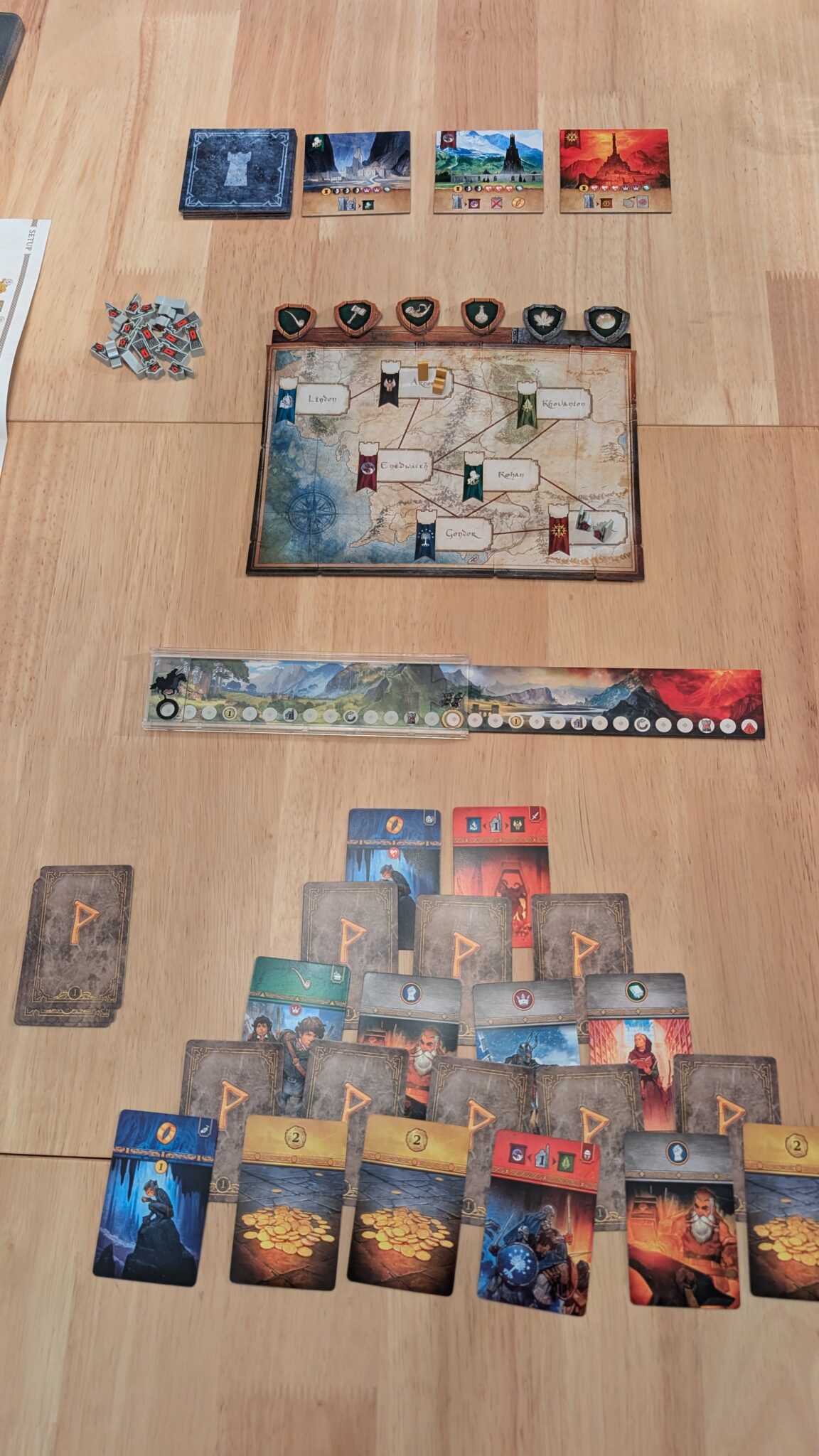
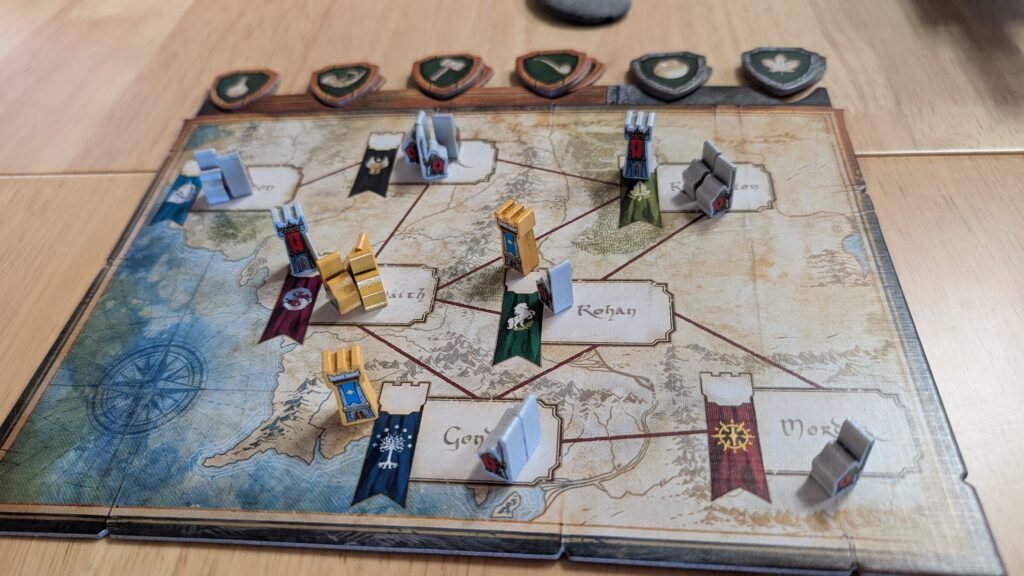
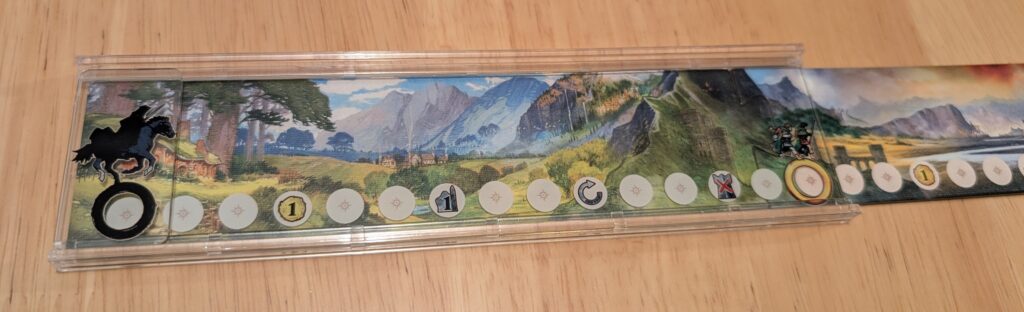
Unlike Seven Wonders’ methodology of collecting blue points cards and supplementing them with points from wonders and guilds, there’s nothing to tally at the end of Duel for Middle Earth. Instead, blue cards advance a ‘ring tracker,’ which journeys the Fellowship’s journey to cast the ring into the fires of Mt. Doom as well as the Nazgul’s pursuit of Sam and Frodo. Blue cards advance the tracker for either player (which is managed by a very cool clear slider to advance the Nazgul along the track behind Sam and Frodo), and you pick up rewards at certain intervals on your journey. The other ways to win the game are similar to Seven Wonders Duel: you can collect green cards to ally with the different races of Middle Earth and occasionally gain powers from them, or you can snag red cards to deploy troops on a battle map of Middle Earth. Deploy troops in every region (or gain fortresses by building Landmark cards, which are superpowered tiles similar to Seven Wonders’s titular Wonders) to win this military victory. Between these aspects and the fact that the Landmarks come from a shared pool and not an individual selection, D4ME becomes a very confrontational game, and there’s a lot more weight to the cards you choose both in how you build your collection and how you counter your opponent’s strategy.
Almost all of these tweaks add depth to the game in a positive way. Adding the battle map makes taking red cards more interesting than a back-and-forth conquest tracker, and the race system gives you enough boons in fair enough increments to prioritize them, even if you’re not going for an alliance victory. Despite the card types not interacting with one another aside from an occasional “chain” (where a symbol on a card you bought in a previous round allows you to pick up a card in a future round for free) it felt dynamic and not like I was being forced into a specific lane. The currency system is also much improved, and it always felt like every dollar you spent mattered. Sure, I was broke for most games, but being able to snag a bunch of currency cards in the beginning and run away with money was thankfully never a problem. Resource scarcity is a big part of both Duel games, but in Seven Wonders I’d occasionally find myself not sweating any of my choices because I had so much spare cash.
An Inconsequential Voyage?
There were only two standout issues I had with Duel for Middle Earth, and one may have stemmed from simply not playing enough games. Namely, it never felt like going for a Ring Tracker victory was worth it. While the incremental rewards for advancing on the tracker were nice (the extra turn bonus being a huge boon), it felt like too daunting a goal. Why spend turns going on the run for no reward when I could just build tangible units or fortresses – structures which can only be removed from the map in very rare circumstances – and try for a military victory? Or gain bigger rewards by going for fewer (albeit more specific) race cards? Maybe I didn’t play enough games to properly grok the best way to win using the ring tracker, but the risk vs. reward didn’t quite tip in the latter’s favor.
The second was the landmark cards themselves. While a majority of them felt pretty powerful, a couple weren’t worth spending 6+ resources on, while Helm’s Deep (adding three units to the Rohan section) felt like locking your opponent out of a military victory if you just kept your forces camping in Rohan. In the end this wasn’t a gigantic issue, as we learned what to pick up, what to skirt, and how to pivot, but still something that should be noted.
There and Back Again
But don’t let the previous paragraphs come off as too harsh. Duel for Middle Earth’s flaws are pretty minor, and even the components of the game that felt weaker in terms of carving a path to victory were still utilized on a regular basis. It forces you to strategize in terms of both military tactics and resource management. It puts you face to face with your opponent, putting you at a disadvantage if you prefer to play the game without interacting. And it gives diverse paths to victory which you rarely feel locked into or unable to experiment with.
15/10 HIGHLY RECOMMEND!!!!!!
