 Join the Discord!
It was a busy month, and I didn’t post consistent updates for any of it – oops! I’ve been spending time working on new card designs, testing a wide swath of games from other developers, and traveling to San Francisco for an absolutely fantastic Kubla Con! If things go my way it’s going to be a summer full of Monster Wasteland playtests, because we’ve still got some balancing left to do before things go live.
It turns out that, although the new scoring system is intuitive and removes a fair bit of housekeeping that gets replaced by decision-making, it makes the game a liiiiiittle too easy. As a result, there are going to be a few changes around here, and I’m doing them all in physical before we update the digital versions (which will be available on Tabletop Simulator and for free on Tabletopia!). However, as a responsible designer, my work isn’t just to “make bad number value go up, make good number value go down” and call it a day. This is a great piece by Design Delve about why that’s a bad idea when changing difficulty settings – it’s focused on video game design, but the principles are the same. I want Monster Wasteland to be difficult, not tedious.
Despite what I just said, there were a couple of necessary number value changes. Civilization points from upgrading Settlements have gone down, Research points from completing Objectives have gone up, and penalties for having too much Bane have gotten higher. But there are also a couple major design philosophy changes which I’m cataloguing in this blog entry for posterity, so feast upon pictures of my work, ye mighty, and despair at my horrible handwriting!
Scaling Back Settlements
Settlements are a major lynchpin of Monster Wasteland: the gameplay loop I’m looking to create begins with building Settlements and gaining material benefits from their first abilities in order to grow your economy, buy items, and complete your tasks. As such, it’s important even new players notice the value of Settlements right out of the gate so their first ability needs to be simple and effective.
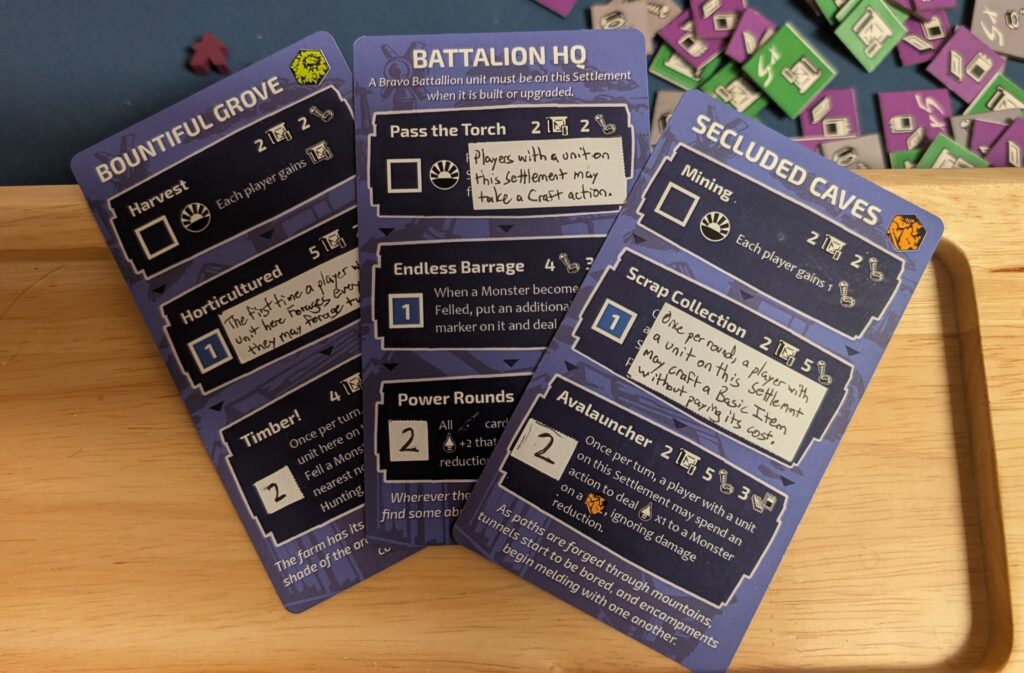
Turns out, some of those abilities were a little too effective, and they became even moreso at higher levels. Raw materials were being given out like candy, and the need for taking an actual ‘forage’ action to gain more raw materials during a player’s turn was almost nonexistent by turn 3 or 4. That’s obviously not the desired gameplay pattern in an 8-round game, so I had to make it more restrictive without giving fewer raw materials (with one exception – The Farmstead is a Settlement that, when fully upgraded, could provide up to 6 raw materials per player per turn. This has been changed down to 4 and may even go to 3 depending on how future tests go).
How am I going about doing that, you ask? Two ways. First off, some abilities needed to be capped from “one action” to “once per a player’s turn,” or from “one per a player’s turn” to “once per round.” Free stuff is neat, but too much of it becomes a problem. Second off, some abilities needed to be prefaced with “If you have a unit on this Settlement…” – this has the threefold effect of making it harder to access the ability (you need to be on the Settlement), capping the people who can access the ability at any given time (there’s a max number of units that can be somewhere at any given time), and encouraging player movement and unit distribution (you gotta get to the Settlement to get its effects). Coincidentally, this last part solves an issue I was having with players ‘camping’ their units and playing out the whole game in their starting areas. It’s a win/win!
Ramping Up Research
Then, there’s the Research deck. This poor little guy went largely unloved during a lot of the games at Kubla Con because it wasn’t giving enough bank for its buck. I’m telling you to go out into the Wasteland, do a bunch of esoteric tasks that use up your actions for no immediate reward, then give you FEWER points than you’d get for upgrading a Settlement and maybe a worse reward to boot? Why on earth would you anyone do that?
Short answer, I don’t know. Long answer, because that used to be the only way you could get points, so it could afford to be a pain in the ass, and I hadn’t scaled the rewards up appropriately.
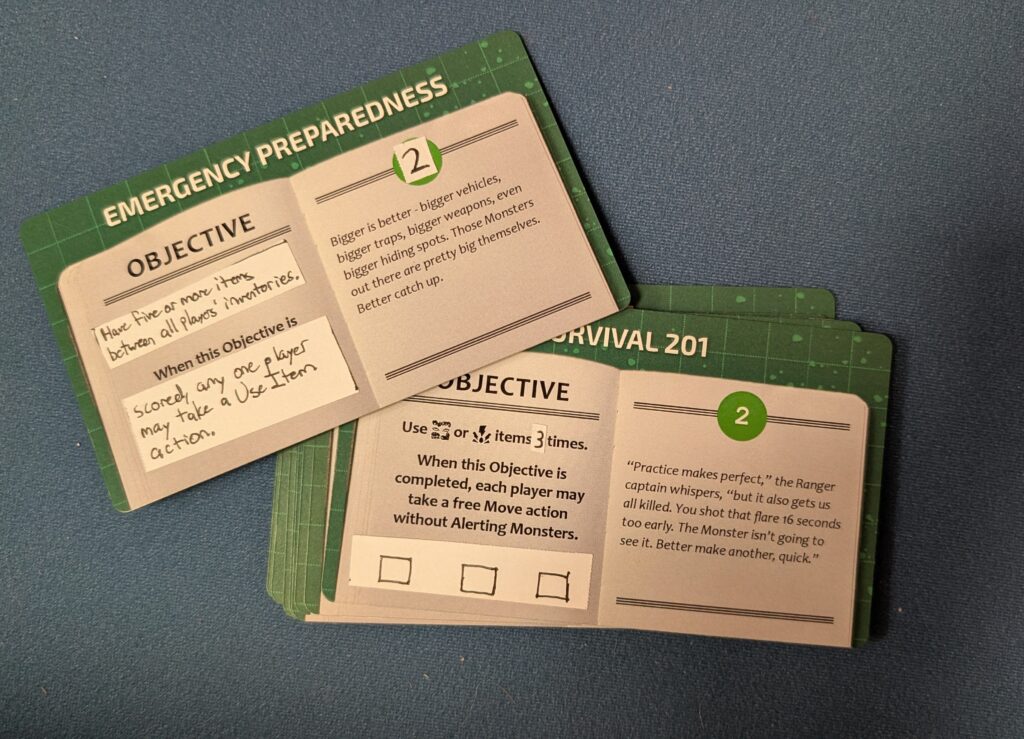
This has now changed, and Research objectives are a combination of easier to complete, worth more points, and more interesting, with better rewards to boot! I know I did a lot of talk about restricting the economy and making the game harder, but I see this as part of that effort too. If you have a lot of good choices, you’ll have to weigh which strategy you want to take more carefully. It’s arguably easier to beat the game if you’re being told to ignore the Research deck because that’s one less option to bog you down. Now you get to make hard (fun!) choices.
Odds & Ends
Of course, there are always minor changes – a number here, a phrasing there – but I won’t bog this blog down with a lot of that. I will, however, list a few that I find interesting/funny before signing off:
- Raw Materials will now be color coded on every instance of iconography: grey for metals, green for organics, purple for tech parts.
- Items briefly went into separate decks for Basic and Premium, but are now back in one. Turns out the ratio of items was slightly off, and we don’t need an extra deck taking up space.
- It’s now explicit that if a Monster kills a unit by moving, it stops its movement the space adjacent to where it killed that unit.
- Rewards for multiple Tales have gotten worse. Sorry for the inconvenience.
- A ‘vehicle’ item subtype watermark has been added to the Military Transport’s Encounter card. Yes, it was somehow technically not a vehicle until this point.
- A couple Monsters are slightly hardier (bad number go up, sorry)
- The Deep Dweller now has a movement of only one. Ranged attack is dangerous!
- It’s now cheaper to craft the Nuke off the Engineer’s Encounter card.
Until next time!
