 Join the Discord!
Technology is awesome: it lets you play board games on your computer!
I’ve said it before and will probably never stop saying that programs like Tabletop Simulator are the reason Monster Wasteland made it this far. The first version of this game just so happened to dovetail with the rise of the COVID-19 pandemic, so if a friend hadn’t told me there are programs out there that host custom board games to play online, the idea may have died as quickly as it was born. Testing with friends, friends of friends, and eventually strangers through 2020 and 2021 got this game off the ground and made it into what it is today and for that, I’m forever thankful.
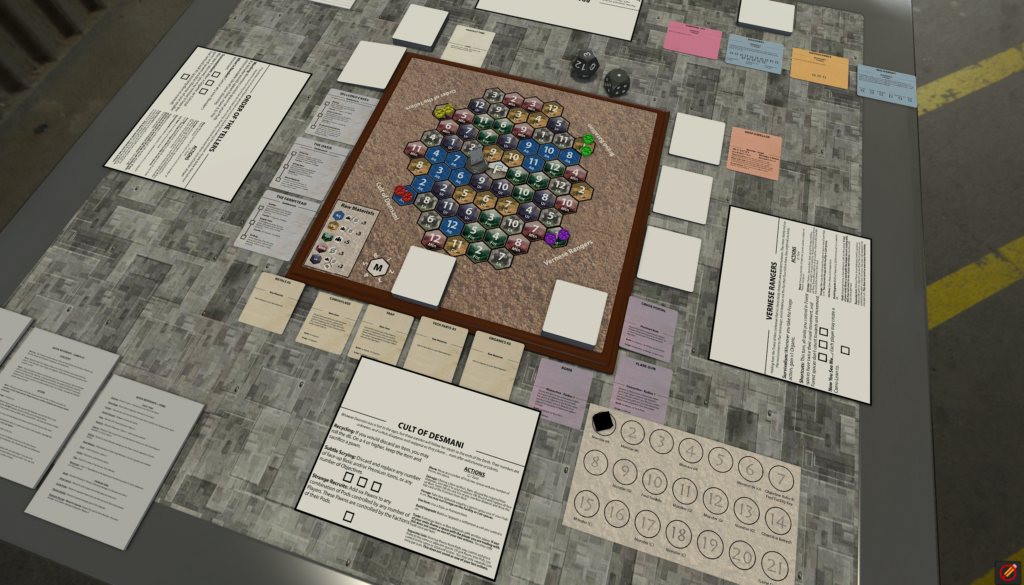
I’m also forever needing to remind myself of a few key ways in which the software can’t possibly replicate the physical tabletop experience, and what I need to take into account when playing board games online.
Does This Make Me Look Bloated?
It may seem obvious, but the time distortion that happens to a board game in a program like Tabletop Simulator is significant, and it never favors brevity. On the software’s side you have to account for hosting/network/server glitches, performance problems, and general asset import/render issues. On the player’s side you have to worry about learning controls and hotkeys, getting comfortable with a 3D camera, and then executing precise motions like selecting components, searching decks/hands, and moving lots of tiny units.
These things add up. Grabbing tokens from multiple piles requires more effort, so let’s say it takes 30 seconds for a Monster Wasteland player to grab their different resource combinations when taking the Forage action. Each player will Forage at least once on their turn, so each round of a four-player game now takes an extra 2 minutes. An average Monster Wasteland game is 7 rounds, so playtime has been artificially inflated by almost 15 minutes just because it’s more annoying to individually click and drag tiles in the software than it is to pick them up from your game table. And this is just one factor of gameplay – every time you’re zooming in on a card to read it instead of picking it up, accidentally moving another player’s piece because it was right next to yours when you clicked it, or splitting stacks of tokens to get the right amount, the game gets longer than it actually is.
It becomes a massive headache for an already-large game like Monster Wasteland, which in its final form is about 2 hours for returning players who aren’t looking to achieve an epic victory. In the early days, 2-3 hour play sessions would finish 3 game rounds, and very little progress would be made. Thankfully the core loop was enticing enough to get people to come back, because I don’t know if I would have connected the dots in my early game development days. I will say that this bloat allowed me to be a better observer… when the game’s moving in slow motion, you can catch a lot of nuances you wouldn’t notice otherwise!
Out of Sight, Out of Mind
Another big drawback to using a digital system is having all the information in front of you doesn’t really matter when it’s on a screen. You can’t keep game components in your periphery in the same way when you’re having to maneuver a camera, and this leads to information getting lost or passed over. With a game state as big as Monster Wasteland’s, this can be a big problem.
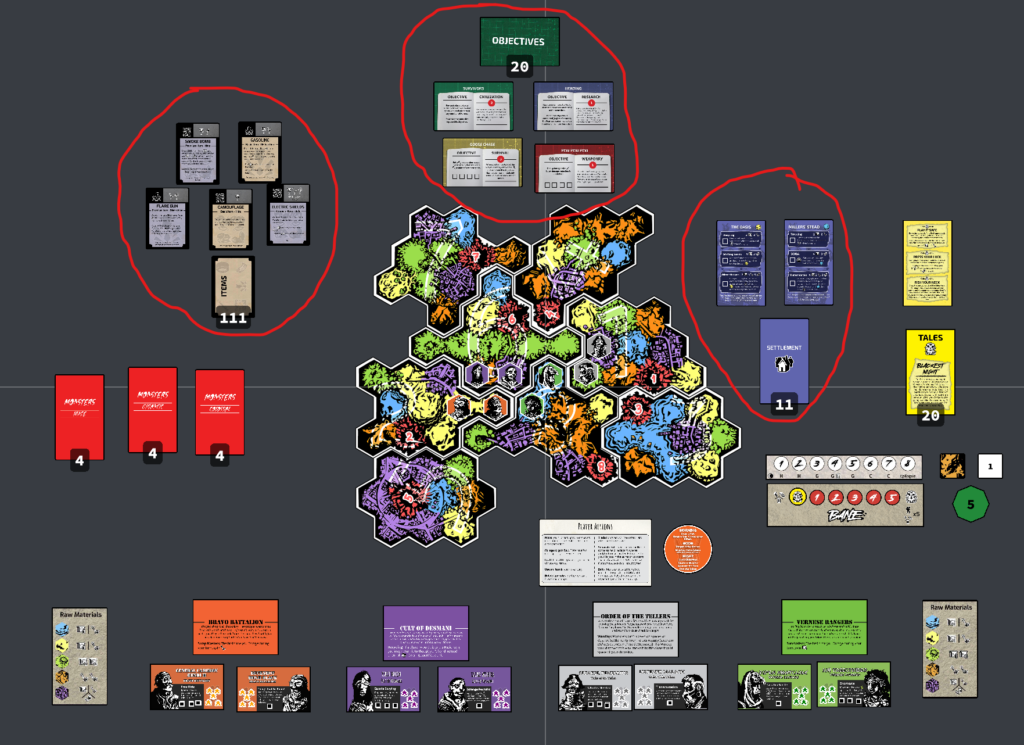
Take this Screentop setup for example. There are three card types that will have relevant face-up information that changes as cards are bought or scored: Items, Settlements, and Objectives. When you’re at a game table, your eyes can dart back and forth between these three face-up piles and you’re able to keep track of them without any real physical effort. When playing online you’re generally zoomed in, and only part of the table is visible to you at any given time. This makes it hard to keep tabs on the different face-up information, and if it’s your first time playing a game you may overlook certain cards, or even card types, just because it’s not somewhere you’re normally working.
Of course, this is a problem that can be mitigated by design. In the example above, the Objective cards are above the map – a choice I thought was logical and intuitive. But when playing the game, players’ attentions are largely going back and forth between their player area and the map. Objectives, being above the map, tended to get cut off by the way players were zooming and scrolling, and thus it was more of a stop and go to figure out what the overall trajectory of player actions should look like. Is there an easy solution to that problem? Absolutely – just put the Objectives under the map so they’ll be in between focal scrolling points! Is that a problem that I would have ever had to contend with in physical play? Almost certainly not in the same way.
Worth the Reach
In the end, problems like these are just things to acknowledge and overcome to the best of your ability. Because Tabletop Simulator, Tabletopia, Screentop, and the up and coming Playtest Parlor which you should absolutely put on your radar are overwhelming boons to the board game (and game design) community.
